At the heart of the new exhibition in the Ethnologisches Museum in the Humboldt Forum are contemporary works by eight artists from Togo and its diaspora. The exhibition forges new connections between colonial memory and contemporary forms of expression such as painting, sculpture, installation, photography, and performance.
Forging new connections and abandoning old ways of thinking are central strategies in dismantling the effects of colonial power structures that have remained in place to this day. This approach focuses in particular on epistemic violence – meaning the power to define knowledge and culture unilaterally, thereby distorting or rendering the perspectives and self-representations of formerly colonised societies invisible. This form of violence also shaped the (museological) representation of Togolese art and culture in Europe.
In this exhibition project, contemporary artists and scholars from Togo connect “collections” in Berlin to various historical and current contexts of Togolese–German relations. At the same time, they forge new connections between institutions in Togo and Germany.
The historical “collections” from Togo
The Ethnologisches Museum Berlin and its preserved historical Togo “collections”—cultural belongings, often violently acquired during the colonial period, as well as historical photographs, and sound recordings—receive particular attention. The contemporary artworks in the exhibition engage directly with these “collections” or contextualise them. In doing so, they generate a productive dialogue that critically questions conventional modes of representation and forges new connections.
New connections as visions of the future
The emergence of new connections signifies a move beyond one-sided narratives, cultivating networks of relations that strengthen and visualise historically marginalised perspectives. This new postcolonial exhibition strategy both reflects colonial traces and drafts a future-oriented global society.
Projekt-Info
Region: Togo
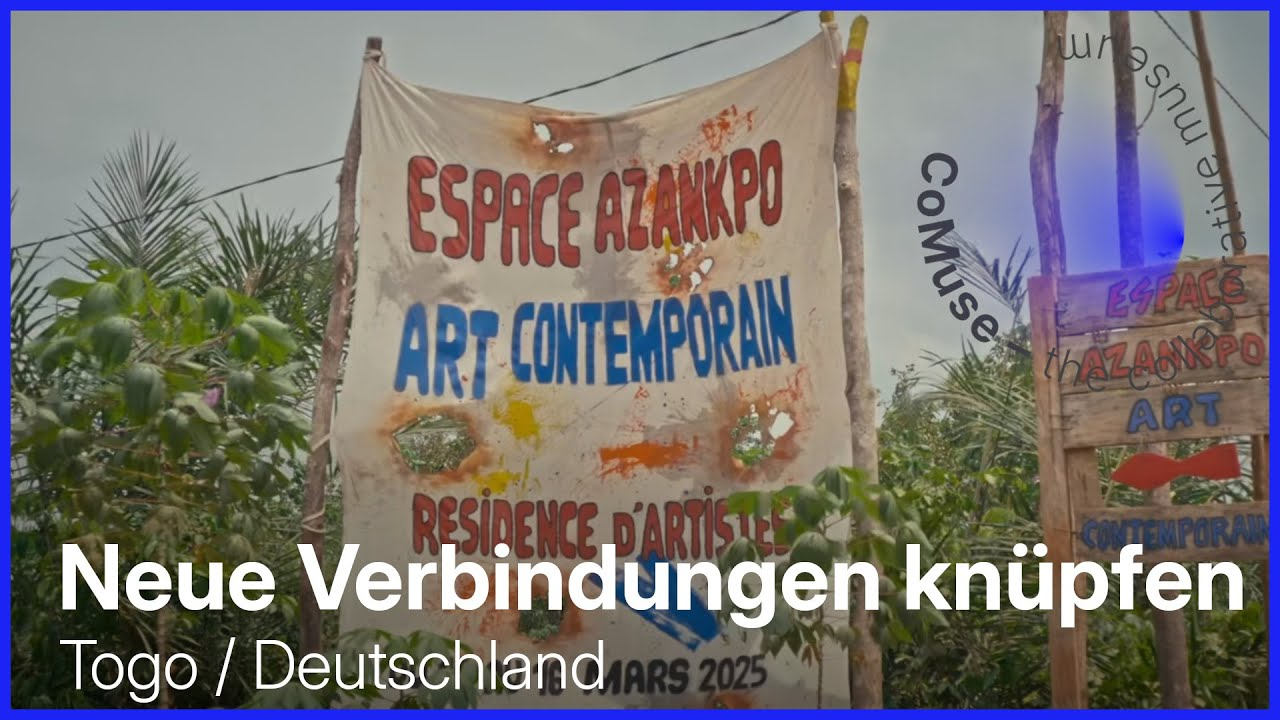
Cooperation partners: ESPACE AZANKPO
Head of the project: Dr. Verena Rodatus
Project coordination: Simone Maria Graf
Curatorial Team: Dr. Verena Rodatus, Curator West Africa / Southern Africa (EM), Dr. Gitti Salami, Guest Scientist (EM), Cristina Navarro (EM/AKu, Digital and Media) with artistic advice from Camille Tété Azankpo and Emmanuel Sogbadji, and in collaboration with Togolese artists and scholars.
Artists: Camille Tété Azankpo, Emmanuel Sogbadji, Sadikou Oukpedjo, Jerry Doe Orlando, Jacques Do Kokou, Anani Dodji Sanouvi, Yasmine Yerima Rouquaiya, Elotode Sokpoh.
Participants in the Kick-off Workshop: Esswassam Abika, Dr. Kokou Azamede, Dr. Sama Missimba Wembou, Dr. Adama Ayikoué, Dr. Aka Bebewou, Dr. Aqtime Edjabou, Stéphane Kossi Kouzan, Prof. Dr. Edinam Kola, Prof. Dr. Hans Peter Hahn, Dr. Ohiniko M. Toffa, Drossilia D. Igouwe, as well as the artists.
Research: Dr. Verena Rodatus, Dr. Gitti Salami in collaboration with the scientific participants of the kick-off workshop.
Provenance: Dr. Ohiniko M. Toffa
Film: Matthieu Abalo
Design: Studio NEIDA
Restoration: Eva Ritz, Elisabeth Bär
Communication: Deo Gratias Panou, Timo Weißberg (until 07/2025)
Administration: Berit Kintschil, Frank Dreblow
We thank all named and unnamed contributors and team members, especially the CoMuse project team, the Head of the Ethnologisches Museum, and the staff of the Stiftung Preußischer Kulturbesitz . We also extend our thanks to the Ministry of Culture of Togo, the Goethe Institute Lomé, the German Embassy in Lomé, the Togolese Embassy in Berlin, the local community in Ahépé, as well as all participants of the workshop in March 2025.
Project funding: CoMuse
Project duration: 01/2025 – 12/2026